



Blockchain’s influence on online poker operates at multiple layers simultaneously: payment infrastructure, game integrity verification, identity management, and contract execution. Each layer addresses a different trust problem that has existed in online poker since its inception. Understanding how these systems work—and where they currently fall short—requires separating the technical reality from the considerable hype surrounding blockchain in gaming.
The core value proposition is verifiable trust. Traditional online poker requires players to trust that the site shuffles cards fairly, pays out correctly, and holds funds securely. Blockchain-based systems can replace some of that trust with cryptographic verification. The trade-off is complexity: verifiable systems require technical literacy to use correctly, and decentralized infrastructure introduces new failure modes alongside the ones it eliminates.
This article examines the specific technical mechanisms through which blockchain is changing online poker, assesses which changes have operational significance today, and identifies where the technology remains immature. Players evaluating cryptocurrency-based poker platforms need a clear technical picture—not a promotional one.

The Trust Architecture of Traditional Online Poker
To understand blockchain’s impact, it helps to map what players currently trust when playing on a centralized poker platform. The trust stack has five layers: the random number generator (RNG) produces fair card distributions; the game logic applies rules correctly; the payment system credits and debits accounts accurately; the platform stores funds securely; and the operator behaves honestly over time.
Traditional platforms address these through third-party auditing (eCOGRA, iTech Labs), licensing requirements, and regulatory oversight. These mechanisms work reasonably well but have a fundamental limitation: they’re attestations, not proofs. An auditor certifies that a system was operating correctly during a review period—it cannot guarantee the system hasn’t been modified since.
Blockchain-based systems can replace attestations with cryptographic proofs for some of these layers. The key word is “some”—blockchain doesn’t solve all trust problems in poker, and understanding which problems it actually addresses is essential for evaluating its real impact.
Provably Fair Systems: The Technical Mechanism
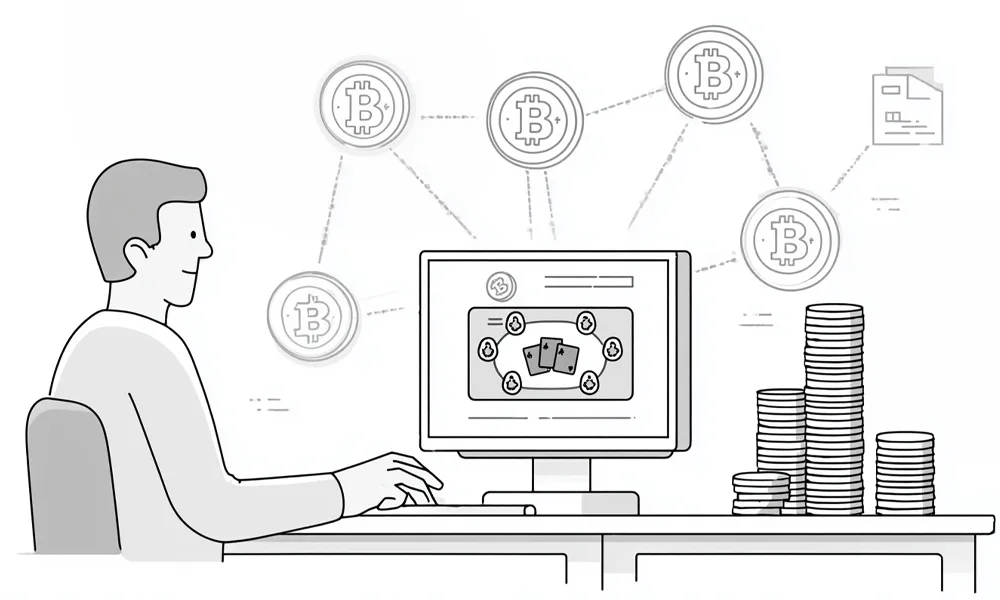
Provably fair is the most technically significant blockchain contribution to poker integrity. The mechanism uses cryptographic commitment schemes to prove that card distributions were determined before a hand began and weren’t modified afterward.
How Commitment Schemes Work in Poker
In a provably fair implementation, the server generates a random seed before the hand, hashes it using a cryptographic function (SHA-256 is standard), and publishes the hash to the player. After the hand completes, the server reveals the original seed. The player can verify that the hash of the revealed seed matches what was published before the hand—proving the server couldn’t have changed the seed during play.
A complete implementation also incorporates a client seed provided by the player, combined with the server seed to produce the final card distribution. This eliminates the possibility that the server knew the “random” outcome in advance, since the final result depends on player-supplied data the server couldn’t predict.
Current Limitations of Provably Fair Poker
Provably fair systems solve the card-fixing problem but don’t solve all integrity problems. They don’t prevent: selective disconnection attacks (disconnecting players at advantageous moments), collusion between players, or manipulation of payout calculations outside the card distribution. A platform can have a provably fair RNG and still manipulate outcomes through other mechanisms. Players should understand what provably fair verifies and what it doesn’t.
Verification also requires player action—most players don’t actually check the cryptographic proofs after each hand. Provably fair provides the capability for verification, not automatic verification. Its value is in the credible threat of being caught, not in automatic protection.
Smart Contracts and Automated Payout Execution
Smart contracts are self-executing programs deployed on blockchain networks that run exactly as coded with no possibility of modification after deployment. In poker, they can automate pot distribution, enforce tournament payout structures, and manage escrow without requiring the operator to manually process each transaction.
What Smart Contract Poker Actually Looks Like
A fully on-chain poker game would store all game state on the blockchain, execute all logic through smart contracts, and pay out through the same contract automatically. The technical reality is that this architecture has significant limitations: on-chain computation is expensive (every action requires a gas fee on Ethereum), blockchain latency is too slow for real-time poker (block times of 12 seconds or more make multi-street betting impractical), and card information cannot be kept private on a public blockchain without additional cryptographic infrastructure.
Current implementations use hybrid architectures: game logic runs off-chain for speed and cost efficiency, while payouts and escrow are managed on-chain for transparency. This captures most of the financial trust benefits while avoiding the performance limitations of fully on-chain execution. Players should understand that “blockchain poker” often means blockchain-settled poker, not blockchain-executed poker—an important distinction for evaluating trust claims.
Escrow and Non-Custodial Tournament Prize Pools
The most practically mature smart contract application in poker is escrow management. Tournament prize pools locked in smart contracts cannot be accessed by the operator before the tournament concludes. Payout conditions are enforced by code rather than operator discretion. This directly addresses a real risk—operators absconding with prize pools or delaying payouts—that has materialized multiple times in online poker history.
| Architecture | Game Logic | Payout Execution | Trust Model | Performance |
|---|---|---|---|---|
| Traditional Centralized | Off-chain (server) | Off-chain (operator) | Operator + auditor attestation | Real-time (~ms) |
| Hybrid Blockchain | Off-chain (server) | On-chain (smart contract) | Cryptographic proof (payouts only) | Real-time + settlement delay |
| Fully On-Chain | On-chain (contract) | On-chain (contract) | Full cryptographic verification | Slow (block time dependent) |
Hybrid architectures represent the practical middle ground where blockchain’s trust benefits apply to the highest-risk elements (fund custody and payout execution) without the performance penalties that would make real-time poker unplayable. Most serious blockchain poker implementations today use this model.

Crypto Payments and the Operational Impact on Players
The most immediate and tangible blockchain influence on poker today isn’t game logic—it’s payments. Bitcoin and other cryptocurrency deposits eliminate intermediary payment processors, enabling players in jurisdictions where poker sites struggle with banking access to deposit and withdraw without restriction.
The operational implications are significant. Withdrawal processing that takes 3-5 business days through traditional banking completes in 10-30 minutes via Bitcoin or under 3 minutes via stablecoins on TRC-20. Deposit fees that average 3-5% through credit cards drop to under 1% for most crypto transactions in normal network conditions.
The security model also differs fundamentally. Crypto transactions are push-only—players initiate transfers from their wallets; the poker site cannot pull funds from your wallet without your authorization. This eliminates chargeback fraud and unauthorized withdrawal risks that exist in bidirectional payment systems. The trade-off is irreversibility: a mistaken crypto transaction cannot be reversed, requiring careful address verification before every deposit.

Operational Scenario: Verifying a Provably Fair Hand
A player suspects a bad beat on a blockchain-enabled poker platform wasn’t random. They want to verify the hand independently.
- Platform uses SHA-256 commitment scheme with combined server + client seeds
- Hand history shows: server seed hash (published before hand), client seed (player-provided), nonce (hand counter)
- After hand: server reveals original seed
- Player verification tool: platform provides open-source verification script
The Verification Process
The player takes the revealed server seed and runs it through SHA-256. The output should match exactly the hash published before the hand began. If it matches, the server seed was fixed before the hand and wasn’t modified. The player then combines the verified server seed with their client seed and the nonce using the platform’s documented combination algorithm, regenerates the card distribution, and confirms it matches what was dealt. The entire process takes under 5 minutes using standard cryptographic tools available in any programming environment.
What This Proves and What It Doesn’t
A successful verification proves the card distribution was determined by the committed seeds and wasn’t changed during the hand. It doesn’t prove the platform didn’t know in advance which cards would appear (impossible if the server seed was chosen maliciously before committing), which is why the client seed contribution is essential—it introduces player-controlled randomness the server couldn’t predict. The verification proves the system worked as designed; it assumes the design itself is sound.
How Blockchain Changes Player Anonymity and Identity
Traditional poker accounts require identity verification (KYC) tied to payment methods. Crypto-native poker platforms can, in principle, allow pseudonymous play—accounts identified by wallet addresses rather than personal information. This has genuine privacy value for players in jurisdictions with restrictive gambling regulations.
The privacy model has important technical nuances. Blockchain transactions are pseudonymous, not anonymous. A wallet address is a pseudonym, but if that address is ever linked to your identity—through an exchange withdrawal, a known deposit address, or address clustering analysis—your complete transaction history becomes visible. Players who value privacy should understand that blockchain provides pseudonymity at the protocol level, not guaranteed anonymity. Additional tools (privacy-focused cryptocurrencies, mixing services, separate wallets per platform) are required for stronger privacy guarantees, each with their own trade-offs and legal considerations in different jurisdictions.
Where Blockchain Poker Is Heading: Protocol-Level Developments
The current generation of blockchain poker implementations is limited by computation costs and latency. Two protocol-level developments are directly relevant to poker’s evolution: Layer 2 scaling solutions and zero-knowledge proof systems.
Layer 2 networks (Lightning Network for Bitcoin, Arbitrum and Base for Ethereum) move transaction processing off the main chain while maintaining security guarantees. For poker, this means near-instant settlement with sub-cent fees—enabling micro-stakes games that are uneconomical on Layer 1 due to transaction costs. Platforms integrating Layer 2 infrastructure will be able to offer stake levels that are technically impossible with current on-chain settlement economics.
Zero-knowledge proofs (ZK-proofs) address the private information problem that has prevented fully on-chain poker. In poker, players must keep their hole cards secret from each other while the contract needs to verify hand rankings at showdown. ZK-proofs allow a player to prove they hold a winning hand without revealing the cards until necessary. This cryptographic primitive, currently being deployed in blockchain scaling solutions, could eventually enable fully verifiable on-chain poker without the private information leakage problem. The technology exists; production-quality poker implementations using it remain in early development stages.
Frequently Asked Questions
What does “provably fair” actually prove in poker?
Provably fair proves that card distributions were determined by a committed seed before the hand began and weren’t modified afterward. It uses cryptographic hashing—the server publishes a hash of its seed before the hand, then reveals the seed afterward for verification. It does not prove the platform isn’t manipulating other aspects of gameplay, such as timing attacks, payout calculations, or collusion detection. It’s a specific integrity proof for the card distribution mechanism only.
Can smart contracts fully replace poker operators?
Not with current technology. Fully on-chain poker faces three unsolved problems at production scale: on-chain computation costs make every action expensive, block confirmation times (12+ seconds on Ethereum mainnet) make real-time multi-street betting unplayable, and keeping hole cards private on a public blockchain requires zero-knowledge proof infrastructure that isn’t yet production-ready for complex poker logic. Smart contracts currently work best for escrow and payout automation, not full game execution.
Is crypto poker truly anonymous?
Crypto poker is pseudonymous, not anonymous. Your wallet address is a pseudonym—it doesn’t reveal your identity by default. However, if your wallet address is ever linked to your real identity (through exchange KYC, on-chain transaction clustering, or deposit address reuse), your full transaction history becomes traceable. Achieving stronger privacy requires additional operational practices: separate wallets per platform, privacy-focused cryptocurrencies, and avoiding address reuse—each with their own technical and legal trade-offs.
What is a hybrid blockchain poker architecture?
Hybrid architecture runs game logic off-chain (on the platform’s servers) for real-time performance while handling fund custody and payout execution on-chain via smart contracts. This captures the financial trust benefits of blockchain—operators can’t abscond with funds or manipulate payouts—without the latency and cost penalties of fully on-chain execution. Most serious blockchain poker platforms today use this model. “Blockchain poker” typically means blockchain-settled, not blockchain-executed.
How do Layer 2 solutions change crypto poker deposits?
Layer 2 networks process transactions off the main blockchain while inheriting its security guarantees. For poker deposits, this means confirmation times dropping from 10–30 minutes (Bitcoin mainnet) to under 5 seconds, with fees falling to sub-cent levels. This makes micro-stakes games economically viable—a $1 buy-in game is currently unworkable when network fees represent 5–50% of the buy-in. Layer 2 adoption is the primary technical development that will expand crypto poker’s accessible stake range downward.
What are zero-knowledge proofs and why do they matter for poker?
Zero-knowledge proofs allow one party to prove a statement is true without revealing the underlying data. In poker, this solves the private information problem: a player can prove they hold a winning hand to a smart contract without revealing their hole cards to other players until the appropriate moment. This cryptographic primitive is what makes fully on-chain poker theoretically possible—without it, card information on a public blockchain would be visible to all participants. ZK-proof poker implementations exist in research and early development but aren’t yet production-ready at scale.