



Managing a Bitcoin poker bankroll requires solving two distinct problems simultaneously: standard poker bankroll management (variance, stake sizing, shot-taking) and crypto-specific risk management (price volatility, custody security, on-chain transaction costs). Players who apply fiat bankroll logic to BTC holdings without accounting for crypto-specific variables consistently make structural errors that compound over time.
The core challenge is that your bankroll has two simultaneous value measurements: BTC units and fiat equivalent. A downswing in BTC terms looks different than a downswing in fiat terms when the underlying asset is moving 10-20% in either direction week-to-week. Bankroll decisions made without clarifying which measurement you’re tracking produce inconsistent results—players either take shots during apparent BTC upswings that mask real fiat losses, or fold winning periods because fiat gains look smaller in BTC terms.
This guide breaks down the operational framework experienced players use to manage cryptocurrency poker bankrolls: how to account for volatility in stake decisions, how to structure custody to minimize risk, and where the standard poker bankroll rules require crypto-specific modification.

The Two-Measurement Bankroll Problem
Every Bitcoin poker player operates with a bankroll that has two parallel valuations: the number of BTC held and the fiat equivalent at current market prices. These measurements diverge constantly, and failing to decide which one governs bankroll decisions creates strategic inconsistency.
Most professional poker players track bankroll in fiat equivalent rather than BTC units, because poker results—win rates, expected value, variance calculations—are denominated in USD or local currency. Buy-ins, blinds, and tournament entry fees are priced in fiat. Tracking your bankroll in BTC units while competing in fiat-denominated games creates a measurement mismatch that distorts stake sizing decisions.
The practical approach: maintain a primary bankroll metric in fiat equivalent, recalculated at current market rates. Track BTC unit holdings separately as an asset position. When making stake sizing decisions, use the fiat equivalent figure. When making custody and allocation decisions, use BTC units. This separation prevents market movement from distorting game selection logic.
The exception is players who run their entire operation in crypto—buying in, cashing out, and tracking results exclusively in BTC. This model requires consistent BTC-denominated bankroll thresholds and insulates game selection from fiat price noise, but introduces complexity when comparing results across periods with different market conditions.
Volatility-Adjusted Stake Sizing
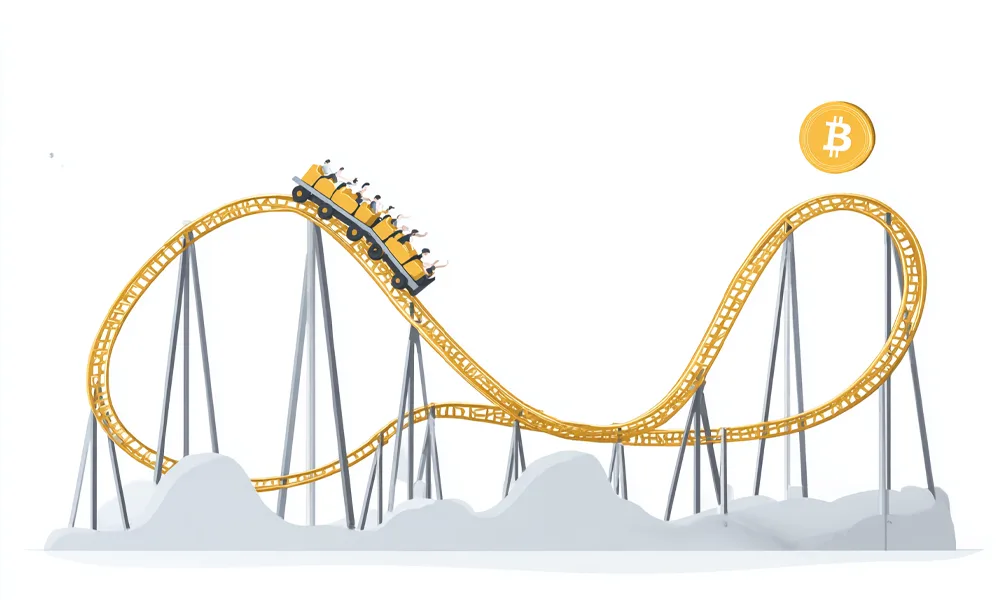
Standard poker bankroll guidelines assume a stable currency. A 20 buy-in bankroll for cash games assumes those buy-ins maintain consistent purchasing power. Bitcoin’s price movement invalidates this assumption: a 20 buy-in bankroll today may be a 16 buy-in bankroll in two weeks if BTC drops 20%, without a single hand being played.
Building a Volatility Buffer
Experienced Bitcoin poker players maintain larger buy-in cushions than fiat equivalents at the same stake level. The standard poker bankroll guidelines provide a baseline—for cash games, 20-30 buy-ins is typical for regular players; for tournament-focused play, 50-100 buy-ins is common due to higher variance. For BTC-denominated play, adding a 20-30% volatility buffer to these baselines provides protection against market drawdowns occurring simultaneously with poker variance.
This buffer isn’t permanent capital reservation—it’s a liquidity cushion that prevents forced stake reductions driven by market movement rather than actual poker results. A player running 30 buy-ins at their stake who loses 6 buy-ins to a downswing and simultaneously sees BTC drop 15% is functionally closer to a 20 buy-in position. Without the buffer, this combination forces a stake reduction that wouldn’t be warranted by poker results alone.
Common Mistakes Players Make
- Moving up stakes after a BTC price appreciation that increases fiat bankroll value, without a corresponding improvement in win rate or game selection—mistaking asset appreciation for earned bankroll growth.
- Calculating buy-in counts at a favorable market rate and then not recalculating when the market moves, creating an inflated sense of bankroll depth during price declines.
- Running bankroll minimums based on BTC units rather than fiat equivalent, which causes effective buy-in counts to shrink during bear markets and expand during bull markets independent of play results.
- Ignoring network fees as a bankroll cost—treating deposit and withdrawal fees as frictionless when they represent real percentage costs, particularly at lower stakes.
- Confusing short-term BTC price movement with win/loss attribution, leading to inaccurate assessment of actual poker performance relative to market exposure.

Hot Wallet vs. Cold Storage Allocation
Bankroll custody architecture is a risk management decision that most fiat poker players don’t need to consider. BTC poker players manage two distinct custody risks: site risk (funds on the poker platform) and wallet risk (funds in self-custody). The allocation between active play funds, hot wallet, and cold storage determines both operational flexibility and security exposure.
The Three-Layer Allocation Model
Professional players typically structure their BTC bankroll across three layers. The first layer is active site balance: funds currently on the poker platform, available for immediate play. This layer carries site custody risk—exchange or platform insolvency, regulatory seizure, or security breaches. Keeping only session-relevant funds on-site limits this exposure.
The second layer is hot wallet: self-custody funds accessible for rapid deposit when needed, held in a software wallet or exchange. This layer provides operational liquidity without the risk of leaving excess funds on the poker platform. Hot wallet size should reflect realistic session frequency and deposit amounts—enough for several sessions without requiring cold storage access.
The third layer is cold storage: the majority of total crypto holdings, secured in hardware wallets (Ledger, Trezor) or other offline storage. Cold storage funds are not operational—they’re reserves that require deliberate action to access, which provides protection against both external attacks and impulsive bankroll decisions during downswings.
The proportion split between layers depends on play volume and risk tolerance. Players who play frequently at higher stakes maintain larger hot wallet balances for operational efficiency. Players who play less frequently or hold larger reserves keep proportionally more in cold storage, accepting minor friction for substantially improved security.

Volatility Management: Stablecoins as a Hedging Tool
Stablecoins provide a middle path between full BTC exposure and fiat currency. Players who want to lock in poker winnings without converting to fiat can move cleared profits into USDT or USDC, preserving fiat value without exiting the crypto ecosystem. This is particularly relevant during periods of high BTC volatility or when a player is on a winning run they want to protect from market reversal.
The trade-offs are explicit: USDT and USDC carry smart contract risk, centralized issuer risk (Tether and Circle respectively), and potential regulatory exposure. These risks are different from BTC’s market volatility risk—neither superior nor inferior, just structurally different. Players should understand both risk profiles before deciding on stablecoin allocation.
A practical stablecoin strategy for poker players: convert a defined percentage of monthly poker profits to stablecoins as a “realized gains” reserve. This reserve is separate from the active bankroll and functions as a drawdown buffer. If BTC drops significantly and poker results also go negative, the stablecoin reserve provides a capital base that hasn’t been affected by market movement. The reserve size should reflect your comfort threshold for simultaneous poker variance and market drawdown.
Operational Scenario: Bankroll Decision During Market Decline
A player maintains a BTC poker bankroll structured as follows at the start of a month:
- Active site balance: 0.05 BTC (approximately 5 buy-ins at current market rates)
- Hot wallet: 0.15 BTC (approximately 15 buy-ins at current market rates)
- Cold storage: 0.80 BTC (reserve, approximately 80 buy-ins at current market rates)
- Stablecoin reserve: $2,000 USDT (prior profits converted, not counted in buy-in calculation)
The Technical Process
Mid-month, BTC’s market price declines 25%. The player’s total BTC holdings haven’t changed in unit terms—they still hold 1.0 BTC—but the fiat equivalent of their active + hot wallet position has dropped from approximately 20 buy-ins to approximately 15 buy-ins. Simultaneously, the player has experienced a 3 buy-in downswing at the tables. Effective operational bankroll: approximately 12 buy-ins in fiat equivalent.
Without the stablecoin reserve and pre-planned volatility buffer, this combination would trigger a forced stake reduction. With the framework in place, the player recognizes: (1) the market decline is unrealized loss, not poker loss; (2) the poker downswing is within normal variance at their win rate; (3) the stablecoin reserve provides capital continuity without requiring cold storage liquidation. The player continues at their current stake and recalculates their bankroll position weekly rather than reacting to daily price movement.
The Outcome
By month end, BTC recovers partially and the player books a winning month at the tables. The stablecoin reserve was never accessed. The cold storage was never touched. The framework prevented a reactive stake reduction that would have been driven by market movement rather than actual bankroll management principles. The key discipline: pre-defining the rules before the volatility event, not during it.
How Professionals Structure Long-Term BTC Bankroll Growth
Experienced players treat their BTC poker bankroll as a managed position with defined growth and withdrawal rules, not as a passive holding that fluctuates with markets. The rules are set when conditions are stable, not during swings.
Profit Extraction Framework
Professional players define extraction rules before each period: what percentage of poker profits to retain in the active bankroll, what percentage to convert to stablecoins or fiat, and what threshold triggers a stake move up or down. These rules are based on fiat equivalent bankroll size, not BTC unit count. Extraction to cold storage or stablecoins happens on a schedule—monthly or quarterly—not reactively. Players using the ACR Poker software can track session results directly in the platform, separating poker performance data from market movement to maintain clean win rate calculations.
Rebalancing After Market Events
After significant BTC price movements—either direction—professional players perform a formal bankroll rebalancing: recalculate fiat equivalent across all layers, verify that buy-in counts remain within target ranges, and adjust hot wallet allocation if operational needs have changed. During sustained bull markets, they avoid the trap of moving up stakes based on paper appreciation. During sustained bear markets, they distinguish between poker-driven bankroll decline and market-driven fiat equivalent reduction, making stake decisions based on the former not the latter.
Tax and Regulatory Accounting for BTC Poker Bankrolls
BTC poker bankrolls create accounting complexity that fiat bankrolls don’t. Each deposit to a poker site may constitute a taxable disposal in jurisdictions that treat crypto as property. Each withdrawal may trigger a capital gain or loss calculation based on the difference between acquisition cost and disposal value at the time of the transaction. Poker winnings themselves may be separately taxable as gambling income.
The operational implication: maintaining accurate records of BTC acquisition cost (cost basis), deposit amounts and dates, withdrawal amounts and dates, and fiat equivalent values at each transaction point is necessary for tax compliance. This is not financial or legal advice—tax treatment of crypto poker activities varies significantly by jurisdiction, and qualified professional advice is essential. The point is that bankroll management for BTC poker players includes record-keeping as a core operational requirement, not an afterthought.
Frequently Asked Questions
Should I track my Bitcoin poker bankroll in BTC or fiat?
Track bankroll for stake sizing decisions in fiat equivalent, recalculated at current market rates. Track BTC unit holdings separately as an asset position. Poker results—win rates, variance, buy-in counts—are fiat-denominated even in crypto poker. Using BTC units for bankroll decisions creates measurement mismatches when market prices move, distorting stake sizing logic independently of actual play results.
How much of my BTC bankroll should I keep on the poker site?
Keep only session-relevant funds on the poker platform—enough for your active sessions plus a small buffer for convenience. The poker site carries custody risk (platform insolvency, security breach, regulatory action) that self-custody eliminates. The remainder belongs in a hot wallet for operational liquidity and cold storage for reserve security. Most professional players maintain 5-15% of total bankroll on-site at any given time.
How do I handle a BTC price drop during a poker downswing?
Separate the two events analytically before making any decisions. Calculate how much of your fiat equivalent bankroll reduction is attributable to market movement versus actual poker losses. Stake decisions should respond to poker-driven bankroll reduction, not market-driven fiat equivalent changes. Pre-defining your volatility buffer and move-down thresholds before market events prevents reactive decisions made under combined pressure from variance and price movement.
Are stablecoins a good tool for protecting poker profits from BTC volatility?
Stablecoins effectively protect fiat value of poker profits from BTC price movements, but introduce different risks: smart contract vulnerabilities, centralized issuer risk (Tether, Circle), and potential regulatory actions against specific stablecoin issuers. For players who want to preserve profit value within the crypto ecosystem without converting to fiat, stablecoins are a practical tool—provided these trade-offs are understood and the reserve is sized relative to total bankroll rather than used as a primary holding.
How do standard bankroll management rules change for Bitcoin poker?
Standard guidelines (20-30 buy-ins cash, 50-100 buy-ins tournaments) remain the baseline, but require a 20-30% volatility buffer on top. Network fees become a real bankroll cost to factor into stake viability at lower limits. Custody architecture replaces the simple “keep funds in your account” model with a three-layer approach. Profit extraction rules need to account for taxable disposal events that don’t exist in fiat poker. The variance math doesn’t change—only the currency management layer on top of it.
Do network fees meaningfully impact Bitcoin poker bankroll management?
At lower stakes, yes—significantly. If BTC network fees range $5-30 per transaction during normal to congested periods, frequent depositing at micro-stakes erodes a meaningful percentage of session bankroll. Professional players batch transactions (consolidating multiple deposits into one), use SegWit addresses for 30-40% fee reduction, and time deposits during low-congestion windows to minimize fee impact. At higher stakes, fees become a negligible percentage of deposit size and have minimal impact on bankroll management.