



Not all cryptocurrency options are equal in a poker context. Each blockchain protocol has distinct confirmation times, fee structures, finality guarantees, and custody trade-offs that directly affect deposit timing, withdrawal costs, and bankroll management. Choosing the right crypto for poker transactions isn’t a preference question—it’s an operational one.
Players who treat all cryptocurrencies as interchangeable miss significant efficiency and cost differences. A Bitcoin deposit during network congestion and a Litecoin deposit under the same conditions produce radically different outcomes in speed and cost. Understanding why requires knowing how each protocol handles transaction validation, block production, and fee markets.
This guide breaks down the technical characteristics of the major cryptocurrencies accepted at crypto poker sites, explains the operational implications for deposits and withdrawals, and identifies which options suit which use cases. The goal is to help experienced players make informed decisions based on protocol mechanics, not marketing claims.
How Protocol Differences Create Real Operational Gaps
Every cryptocurrency processes transactions through its own consensus mechanism, block time, and fee market. These protocol-level differences determine how quickly deposits confirm, how much network fees cost, and how predictable those costs are under varying network conditions. For poker players, the relevant variables are confirmation time (how long before funds are available), network fee cost (what you pay the blockchain, not the site), and fee volatility (how much costs fluctuate based on demand).
Sites set their own confirmation requirements per cryptocurrency—typically calibrated to provide equivalent security across different networks. A Bitcoin deposit requiring 3 confirmations (approximately 30 minutes) provides similar double-spend protection to 20 Tron confirmations (approximately 2 minutes). The security level is comparable; the time cost is not.
The following sections examine each major cryptocurrency through this operational lens: what the protocol does, what that means for deposits and withdrawals, and where it performs well or poorly in a poker context.
Bitcoin (BTC): Maximum Security, Variable Cost
Bitcoin operates on proof-of-work consensus with 10-minute average block times. Sites typically require 2–3 confirmations, meaning deposits take 20–40 minutes under normal conditions—longer during high-congestion periods when block space is contested. Bitcoin’s transaction fees are determined by a competitive fee market: users bid for inclusion in the next block by setting a fee rate in satoshis per virtual byte (sat/vB).
Under normal network conditions, fees range from $1–10 per transaction. During congestion events—typically correlated with price volatility or high on-chain activity—fees can spike to $30–60+ and remain elevated for hours or days. The 2021 bull run saw sustained periods where Bitcoin fees exceeded $50 per transaction, making small deposits economically irrational.
Where Bitcoin Performs Best
Bitcoin’s advantages in a poker context are security and settlement finality. Its proof-of-work consensus and 15+ years of network operation make it the most battle-tested settlement layer in crypto. For large transfers—moving significant bankroll amounts between cold storage and active play—Bitcoin’s security model is unmatched. The fee cost becomes proportionally negligible at higher amounts: a $15 fee on a $5,000 transfer represents 0.3%, well within acceptable range.
Where Bitcoin Underperforms
Bitcoin is poorly suited for frequent small deposits. A $50 deposit during congestion with a $20 fee represents a 40% overhead cost. Players making multiple small top-ups per session will find Bitcoin’s fee market prohibitively expensive during peak periods. Always check mempool.space for current fee conditions before sending Bitcoin deposits—fee rates can vary 10–20x within a single day.
Ethereum (ETH): Fast Finality, Gas Complexity
Ethereum transitioned to proof-of-stake consensus in 2022, significantly changing its finality model. Under proof-of-stake, Ethereum reaches probabilistic finality at 12 confirmations (approximately 3 minutes) and absolute finality through checkpoint epochs (approximately 12–13 minutes). Most poker sites accept deposits after 12 confirmations, making ETH deposits among the faster options for a major blockchain.
Ethereum fees (called gas) are denominated in Gwei and paid to validators. Gas costs depend on network demand and the complexity of the transaction. Simple ETH transfers consume less gas than token transfers (ERC-20), which require smart contract execution. During low-demand periods, ETH transfers cost $1–5. During high-demand periods (NFT mints, DeFi activity, market volatility), gas prices spike significantly—the 2021 peak saw transaction costs exceeding $100 for complex operations, though simple transfers remained lower.
Where Ethereum Performs Best
Ethereum’s combination of reasonable speed (3–5 minute confirmation) and broad wallet support makes it a practical choice for medium-to-large deposits where confirmation speed matters more than fee minimization. Its proof-of-stake finality model also provides strong security guarantees comparable to Bitcoin for practical purposes. Players already holding ETH for other uses—DeFi, NFTs, staking—avoid conversion costs by depositing directly.
Where Ethereum Underperforms
Gas fee unpredictability is Ethereum’s primary operational weakness. Players cannot reliably predict what a deposit will cost without checking real-time gas prices via tools like etherscan.io or wallet fee estimators. Token deposits (USDT-ERC20, USDC-ERC20) cost more than plain ETH transfers because smart contract execution consumes additional gas. For players seeking predictable, low-cost transactions, Ethereum is not the optimal choice.
Litecoin (LTC): The Consistent Performer
Litecoin is a Bitcoin fork with modified parameters: 2.5-minute block times (4x faster than Bitcoin) and a different proof-of-work algorithm (Scrypt vs. SHA-256). Sites typically require 6 confirmations, which takes approximately 15 minutes—faster than Bitcoin’s 2–3 confirmation requirement despite needing more confirmations, due to the shorter block interval.
Litecoin’s fee market operates similarly to Bitcoin’s but with consistently lower demand. Network fees typically range $0.05–0.20 regardless of market conditions, making costs predictable across time. During the 2021 Bitcoin congestion peak, Litecoin fees remained under $0.50 while Bitcoin fees exceeded $50—a 100x cost difference for equivalent economic transfer.
Where Litecoin Performs Best
Litecoin is the most operationally consistent option for frequent poker deposits and withdrawals. Predictable fees, reliable confirmation times, and broad site support make it the practical default for players who deposit and withdraw regularly. It’s particularly well-suited for session-based bankroll management—depositing before each session, withdrawing after—where fee predictability and moderate speed matter more than maximum security or minimum confirmation time.
Where Litecoin Has Limitations
Litecoin’s security model, while sound, has lower hashrate than Bitcoin—making it theoretically more susceptible to 51% attacks than Bitcoin, though no successful attack has occurred on the main chain. For large transfers where security is the primary concern, Bitcoin remains the stronger choice. Litecoin’s lower liquidity on exchanges can also create slightly wider spreads when converting from fiat.
Stablecoins (USDT, USDC): Volatility Elimination With Trade-offs
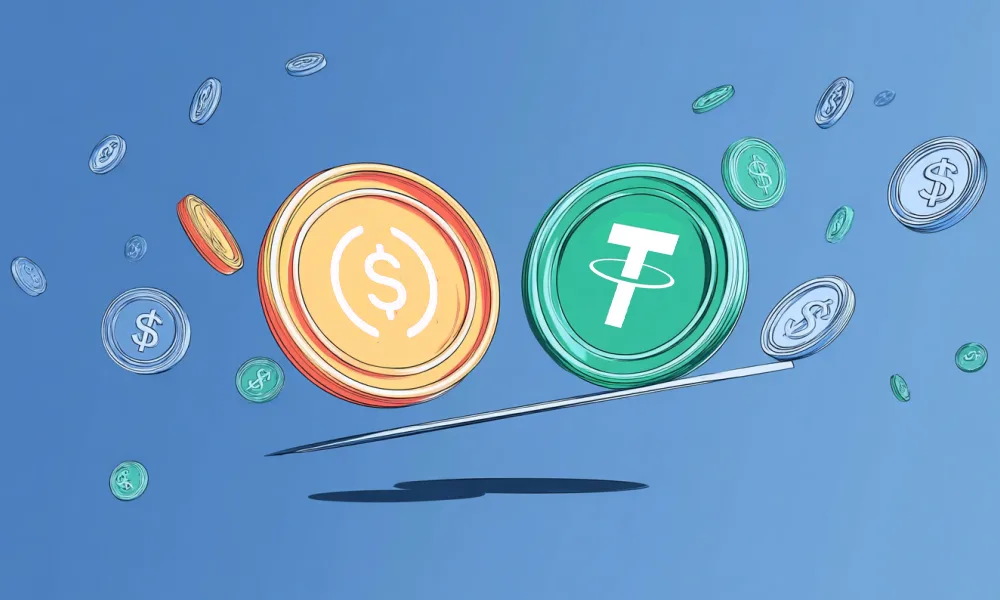
Stablecoins eliminate cryptocurrency price volatility by pegging value to fiat (typically USD). USDT (Tether) and USDC (USD Coin) are the most widely accepted at poker sites. Both operate across multiple blockchain networks, and the network choice determines confirmation time and fee cost—not the stablecoin itself.
| Cryptocurrency | Avg. Confirmation Time | Typical Fee Range | Fee Volatility | Best Use Case |
|---|---|---|---|---|
| Bitcoin (BTC) | 20–40 min (2–3 confirmations) | $1–10 normal, $30–60+ congestion | High | Large, infrequent transfers |
| Ethereum (ETH) | 3–5 min (12 confirmations) | $1–5 normal, gas-dependent | Medium–High | Medium deposits, speed priority |
| Litecoin (LTC) | 10–15 min (6 confirmations) | $0.05–0.20 | Low | Frequent deposits and withdrawals |
| USDT/USDC (TRC20) | 2–3 min (20 confirmations) | $0.50–1.50 | Low | Volatility-sensitive bankrolls |
| USDT/USDC (ERC20) | 3–5 min (12 confirmations) | $2–15 normal, gas-dependent | Medium–High | Volatility protection, ETH ecosystem |
USDT on Tron (TRC20) offers the fastest confirmation and lowest fees of any major option—2–3 minutes and $0.50–1.50 per transaction under normal conditions. USDT or USDC on Ethereum (ERC20) provides similar confirmation speed but higher and less predictable fees due to Ethereum’s gas market. Players choosing stablecoins should specify the network explicitly when depositing—sending ERC20 tokens to a TRC20 address results in permanent fund loss.
Stablecoin Risk Profile
Stablecoins eliminate price volatility but introduce different risks. USDT is issued by Tether Ltd., which maintains reserves to back the peg. USDC is issued by Circle, with more transparent reserve reporting. Both are centralized entities—their failure, regulatory action, or reserve shortfall would affect token value. Smart contract vulnerabilities on the underlying blockchain represent an additional risk layer absent from native assets like BTC or LTC. Players treating stablecoins as “safe” relative to other crypto are conflating price stability with risk elimination—the risk profile is different, not absent.
Operational Scenario: Choosing the Right Crypto for a Tournament Deposit
A player needs to deposit funds 45 minutes before a major tournament. They hold BTC, LTC, and USDT-TRC20 in their wallet and need to choose which to use.
- Current Bitcoin mempool: elevated congestion, next-block fee at 65 sat/vB (above normal range)
- Litecoin network: normal conditions, estimated confirmation in 12–15 minutes
- USDT-TRC20: normal conditions, estimated confirmation in 2–3 minutes
- Tournament requires funds available 10 minutes before start
- Deposit amount: medium-sized buy-in where fee percentage matters
The Decision Logic
Bitcoin is immediately eliminated: elevated congestion means uncertain confirmation time and higher fees. Even at priority rates, there’s no guarantee of confirmation within the 45-minute window during a congestion spike. Litecoin confirms in 12–15 minutes with predictable fees—viable, but leaves limited margin. USDT-TRC20 confirms in 2–3 minutes with the lowest fee cost, providing maximum time buffer and eliminating volatility risk during the tournament. The player uses USDT-TRC20, arriving at the table with funds available 40 minutes before the start.
The Key Principle
Cryptocurrency selection should be driven by current network conditions and operational requirements, not habit. Players who always use Bitcoin because it’s familiar will periodically encounter expensive delays at the worst possible moments. Maintaining wallets across multiple networks allows real-time optimization based on conditions at the time of deposit.
How Professionals Manage Multi-Crypto Poker Bankrolls
Experienced crypto poker players maintain balances across multiple currencies rather than converting everything to a single asset. A typical professional allocation separates long-term storage (Bitcoin in cold storage), medium-term operational funds (Litecoin or ETH in a hot wallet), and session-ready liquidity (USDT-TRC20 for immediate deposits). This structure avoids the need to convert between assets under time pressure—a situation that creates both fee costs and execution risk.
Network Monitoring as Standard Practice
Professionals check network conditions before every deposit using real-time tools: mempool.space for Bitcoin fee rates, etherscan.io gas tracker for Ethereum, and blockchain explorers for Litecoin and Tron activity. This takes under two minutes and can save significant fees or prevent timing failures. Depositing Bitcoin during a fee spike that resolves two hours later represents an avoidable cost—one that network monitoring eliminates. Download the ACR Poker software to review which cryptocurrencies are currently supported and their deposit requirements.
Conversion Timing and Tax Implications
Converting between cryptocurrencies creates taxable events in most jurisdictions. Players who convert BTC to LTC specifically for a deposit trigger a capital gains calculation at the point of conversion. Maintaining separate balances in each currency avoids this friction—each deposit uses the appropriate currency directly without triggering conversion. Players should consult a tax professional familiar with cryptocurrency transactions in their jurisdiction, as reporting requirements vary significantly and are subject to ongoing regulatory change.
Protocol Evolution and What It Means for Poker Players
The cryptocurrency landscape for poker deposits is not static. Bitcoin’s Lightning Network enables near-instant, sub-cent BTC transactions through payment channels—a fundamentally different user experience than on-chain settlement. As poker sites integrate Lightning, Bitcoin becomes competitive on speed and cost for small deposits, not just large ones. Ethereum’s Layer 2 ecosystem (Arbitrum, Optimism, Base) similarly enables fast, cheap ETH and stablecoin transfers with Ethereum-level security.
For players, this means the current speed-cost trade-offs are not permanent. The protocols that are slow or expensive today may offer materially different performance as Layer 2 adoption increases. However, Layer 2 systems introduce their own complexity: different wallet configurations, bridge risks, and liquidity constraints. Early adoption requires technical understanding of these systems before trusting significant funds to them.
Frequently Asked Questions
Which cryptocurrency is fastest for poker deposits?
USDT or USDC on Tron (TRC20) confirms in 2–3 minutes under normal conditions—the fastest of the major options. Ethereum confirms in 3–5 minutes. Litecoin takes 10–15 minutes. Bitcoin is the slowest at 20–40 minutes under normal conditions, extending further during congestion. Speed alone shouldn’t determine your choice—network conditions, fees, and deposit size all factor into the optimal selection.
Why do Bitcoin fees vary so much compared to Litecoin?
Both use fee markets, but Bitcoin’s network processes far higher transaction volume with greater demand for block space. When demand exceeds capacity, users bid up fees to prioritize their transactions. Litecoin has significantly lower network utilization, meaning block space is rarely contested and fees remain stable. The same fee market mechanism exists in both—the difference is demand, not design.
Are stablecoins safer than Bitcoin for poker bankrolls?
Stablecoins eliminate price volatility risk but introduce counterparty and smart contract risk. USDT and USDC depend on their issuers maintaining adequate reserves and operating without regulatory disruption. Bitcoin has no issuer—its value is determined entirely by market demand. Neither is universally safer. The risk profile differs: Bitcoin exposes you to price volatility; stablecoins expose you to issuer and protocol risk.
Does it matter which network I use to send USDT?
Yes—critically. USDT operates on multiple blockchains (Ethereum/ERC20, Tron/TRC20, Binance Smart Chain/BEP20, and others). Sending USDT on the wrong network to an address configured for a different network results in permanent fund loss. Always verify which network the poker site’s deposit address supports before sending. Network selection also determines your fee cost and confirmation time.
Should I convert all my poker bankroll to one cryptocurrency?
No. Maintaining balances across multiple currencies gives you flexibility to optimize each transaction based on current conditions. Holding only Bitcoin means paying elevated fees during congestion or waiting for conditions to improve. Multi-currency wallets let you use Litecoin or stablecoins for routine deposits while reserving Bitcoin for large transfers where its security model justifies the cost and wait time.
What happens to confirmation times during crypto market volatility?
Market volatility typically increases on-chain activity as traders move funds between exchanges and wallets. This raises demand for block space, particularly on Bitcoin and Ethereum, causing fee spikes and confirmation delays for low-priority transactions. Litecoin and Tron are less affected due to lower baseline utilization. During volatile periods, either increase fee priority on Bitcoin/Ethereum or switch to Litecoin or TRC20 stablecoins for time-sensitive deposits.